Commercial Waste Removal Southwark — Health & Safety Policy
Purpose: This policy sets out the commitment of Commercial Waste Removal Southwark to protect the health, safety and welfare of employees, clients and the public while providing professional rubbish removal and commercial waste services across the service area. We prioritise safe systems, correct equipment and clear responsibility.Scope and Commitment
Our policy covers all activities related to commercial rubbish collection, skip and bin operations, transportation and disposal. We aim to prevent injury and ill health by implementing safe working practices, ensuring compliance with relevant industry standards and maintaining a positive safety culture among all staff, contractors and subcontractors.
Responsibility and Roles
Management holds overall responsibility for health and safety. Supervisors and team leaders are accountable for daily risk control, and every operative must follow the safe systems of work. Training, supervision and competence checks will be provided and documented to ensure safe commercial waste removal operations and consistent rubbish clearance standards.All employees must be familiar with specific duties, including correct use of PPE, vehicle safety checks and secure loading. Our vehicles and plant are maintained to minimise mechanical failure and eliminate risks during transportation of trade waste. Record keeping of maintenance, inspections and incident reporting is mandatory to support continuous improvement.
Hazard Identification and Risk Assessment
Regular risk assessments are completed for typical tasks such as manual handling of bulky items, operating compactors, and working at roadside. Assessments consider biological hazards from contaminated refuse, sharps, hazardous liquids and the risks of slips, trips and vehicle collisions. Control measures are implemented and reviewed as conditions change. Safe working practices for our commercial waste services include: scheduled vehicle checks, exclusion zones during loading/unloading, protected lifting techniques and use of specialist containment for hazardous or electronic waste. Staff are instructed to report near misses and are supported to stop work if a task cannot be completed safely.
Training and competency are central. Induction training covers emergency procedures, safe manual handling, segregation of recyclable and hazardous materials, and traffic management. Refresher courses and toolbox talks reinforce safe rubbish removal methods and promote awareness of changing risks. Personal development and competence records are maintained for every operative.
We use a simple hierarchy of controls to manage hazards: elimination where possible, substitution, engineering controls, administrative controls and PPE. Examples include redesigning loading procedures to reduce manual handling, installing guards, and using high-visibility clothing and protective gloves during all collections.
Emergency response arrangements include first aid provision, spill control kits, and clear communication channels when incidents occur. Incidents are investigated promptly to identify root causes and to implement corrective actions that avoid recurrence and improve the safety of future rubbish removal tasks.
Health surveillance and wellbeing measures are provided for roles with identified risks. Where employees are exposed to biological or chemical hazards, appropriate health checks and support are arranged. We also promote safe driving practices for crews undertaking waste collection and disposal across the local service area.
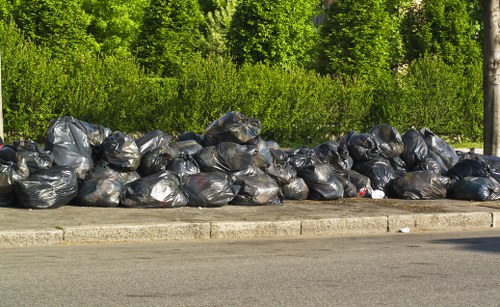 Environmental controls are integrated with safety measures: correct segregation of recyclable materials, containment of hazardous substances, and safe storage prevent environmental contamination while reducing worker exposure. Waste streams are handled according to current best practice for commercial waste management and responsible rubbish disposal.